


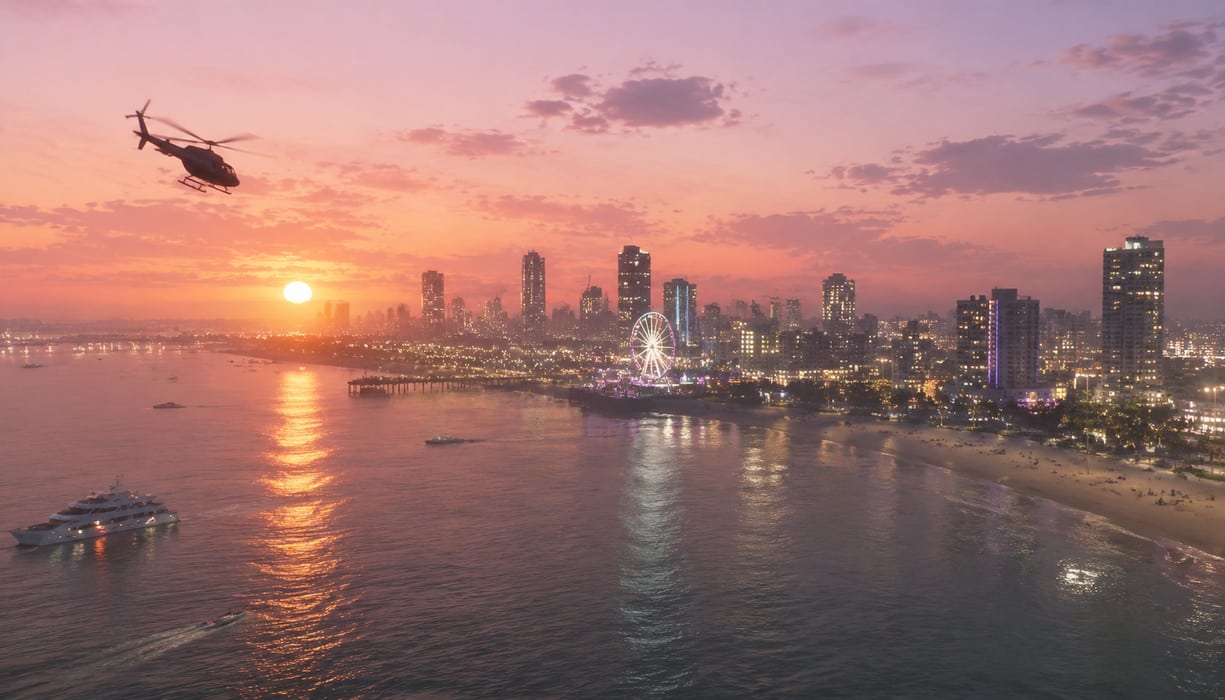
Vice City, the Leonida Keys, Grassrivers, Port Gellhorn, Ambrosia, and Mount Kalaga are the six destinations featured in Rockstar’s Leonida showcase. Together, they introduce a setting that includes urban neighborhoods, tropical islands, wetlands, industrial towns, and northern wilderness.
These destinations are not six equivalent cities. Some are broad natural areas, while others contain smaller neighborhoods, businesses, and landmarks. Keeping those categories separate makes the map easier to understand and prevents a named story location from being mistaken for a fully documented playable area.
Leonida’s Six Confirmed Destinations
| Destination | Environment | Identifying features |
| Vice City | Urban coastline | Beachfront hotels, neighborhoods, markets, and a cruise port |
| Leonida Keys | Tropical archipelago | Island communities, waterfront properties, and boat-related businesses |
| Grassrivers | Wetlands | Mangroves, waterways, and alligators |
| Port Gellhorn | Faded vacation coast | Budget motels and closed tourist attractions |
| Ambrosia | Industrial community | Sugar refining and local biker influence |
| Mount Kalaga | Northern wilderness | Forested terrain, outdoor recreation, and off-road trails |
The table identifies each destination’s setting. It does not establish exact boundaries, driving distances, or access to individual buildings.
Vice City: Confirmed Neighborhoods and Waterfront Locations
Vice City has several named locations within its broader urban setting. Ocean Beach, Little Cuba, the Tisha-Wocka flea market, and VC Port appear in the destination description, giving players specific names to use when identifying scenes and comparing map references.
Ocean Beach
Ocean Beach is associated with white sand and Art Deco hotels. It represents Vice City’s recognizable beachfront setting, but the area name should not be applied to every coastal scene shown in promotional material.
A hotel appearing in the background also does not confirm an accessible interior, a purchasable room, or a mission location.
Little Cuba
Little Cuba is identified through its busy neighborhood bakeries. It belongs in a neighborhood-level location list rather than being treated as a single venue.
When organizing location notes, keep a named business separate from the wider neighborhood containing it. That distinction becomes useful when several buildings appear in the same scene.
Tisha-Wocka Flea Market
The Tisha-Wocka flea market is associated with imitation branded goods. It is a specific market reference, not a confirmed name for an entire district.
Its setting does not establish a player trading system, inventory of purchasable items, or resale mechanic.
VC Port
VC Port is associated with cruise ships and waterfront infrastructure. Use the port name for identified port locations rather than as a general label for marinas, beaches, and other coastal areas.
| Vice City location | Location type | What the name does not establish |
| Ocean Beach | Beachfront area | Access to every visible hotel |
| Little Cuba | Neighborhood | A complete list of businesses |
| Tisha-Wocka flea market | Market | A player-controlled trading system |
| VC Port | Port area | Access to every ship or terminal |
Leonida Keys: Jason’s Island Connections
The Leonida Keys are a tropical island chain with direct connections to Jason Duval and Brian Heder.
Jason’s background places him in the Keys working for local drug runners. Brian operates through a boat yard and lets Jason stay at one of his properties in exchange for help with local shakedowns. These details connect the region to the characters’ existing relationships.
Brian’s boat yard and the property Jason occupies should remain separate location references. Their connection to the same character does not prove they share an address.
The biographies also do not establish a complete opening mission sequence or confirm that either location functions as a player-managed business. A residential property mentioned in a character profile is not automatically a customizable safehouse.
Grassrivers: Wetlands and Waterway Landmarks
Grassrivers is defined by mangroves, wetland terrain, and alligators. Its environment differs sharply from Vice City’s streets and developed coastline.
For location tracking, distinguish a visible landmark from a verified access route. A building across a channel may be identifiable without its road entrance or landing point being known.
A useful Grassrivers entry should record:
- The landmark’s confirmed name, if available.
- The visual evidence used to identify it.
- Whether its approach route has been demonstrated.
- Whether interior access has been verified.
Wildlife sightings need the same care. An alligator shown in promotional material does not establish a repeatable spawn point, respawn timer, or reward. Those details belong in a tested activity guide, not an unverified map entry.
Port Gellhorn: A Vacation Destination in Decline
Port Gellhorn’s identity comes from fading tourism. Cheap motels, closed attractions, and worn commercial areas distinguish it from Vice City’s brighter beachfront image.
That contrast helps when sorting location references, but appearance alone is not enough to assign a scene to the region. Palm trees, coastal roads, and older motels are not unique identifiers.
Prioritize readable signs and individually named venues when building a Port Gellhorn checklist. If a building has no confirmed name, use a plain descriptive label rather than inventing one.
Real-world comparisons should remain comparisons. A resemblance to a Florida town does not establish an exact in-game street layout or position.
Ambrosia: Industry and the Allied Crystal Sugar Refinery
Ambrosia introduces Leonida’s industrial side. The Allied Crystal sugar refinery is a named employer, while a local biker gang provides another source of influence in the community.
The refinery is therefore a specific location reference within the wider Ambrosia setting. Its inclusion does not establish a purchase option, management interface, delivery contract, or passive-income system.
That distinction matters when researching GTA 6 Money. A business appearing in the world is not enough to support an earning strategy. A reliable money guide needs evidence of the activity, its requirements, and its actual payout.
Keep the town, the refinery, and any separately identified venues as distinct entries. Combining them into one marker makes the location list less precise.
Mount Kalaga: Northern Wilderness and Off-Road Terrain
Mount Kalaga is associated with Leonida’s northern border. Its regional description references hunting, fishing, and off-road trails, while official image labels also use the name Mount Kalaga National Park.
A wilderness map benefits from different categories than a city map. Trail entrances, road connections, water access, and named natural landmarks are more useful than forcing every point into a neighborhood structure.
The activity descriptions still have limits. A reference to fishing does not provide a verified fishing spot, species list, equipment requirement, or sale price. Hunting references should not be expanded into untested animal routes or reward tables.
Story Locations That Need Separate Labels
Some named places come from character biographies rather than the six-destination showcase.
Leonida Penitentiary
Lucia’s background names Leonida Penitentiary as the prison where she served time. This establishes its role in her story, not unrestricted access to the facility.
A prison reference alone does not confirm an explorable interior, repeatable prison activity, or player escape mechanic.
Liberty City
Lucia’s biography also references her earlier life with her mother in Liberty City. That is a narrative connection. It does not establish Liberty City as part of the explorable Leonida map.
| Reference type | Appropriate treatment |
| Showcased region | Include in the destination overview |
| Named neighborhood or venue | List as a specific location |
| Place mentioned in a biography | Label as a story reference |
| Community-estimated position | Mark as an unofficial placement |
Map Claims, Property Claims, and Currency Listings
A confirmed place name answers one question: whether that location appears in the published material. It does not automatically answer whether the player can enter, purchase, operate, or earn money from it.
| Claim | Evidence needed |
| A building can be entered | Demonstrated access or an explicit description |
| A property can be purchased | A verified purchase option |
| A mission pays a stated amount | A demonstrated reward and its conditions |
| A route is efficient | Testing that records requirements and travel time |
| A location appears in an online mode | Evidence specifically covering that mode |
An offer labeled GTA 6 Online Money for sale should be assessed separately from a map guide. A commercial listing cannot verify a mission payout, property system, or supported online feature.
For each map marker, record the place name, supporting material, and what that material actually shows. Leave coordinates, interior access, ownership options, and rewards unfilled until each has supporting evidence.