


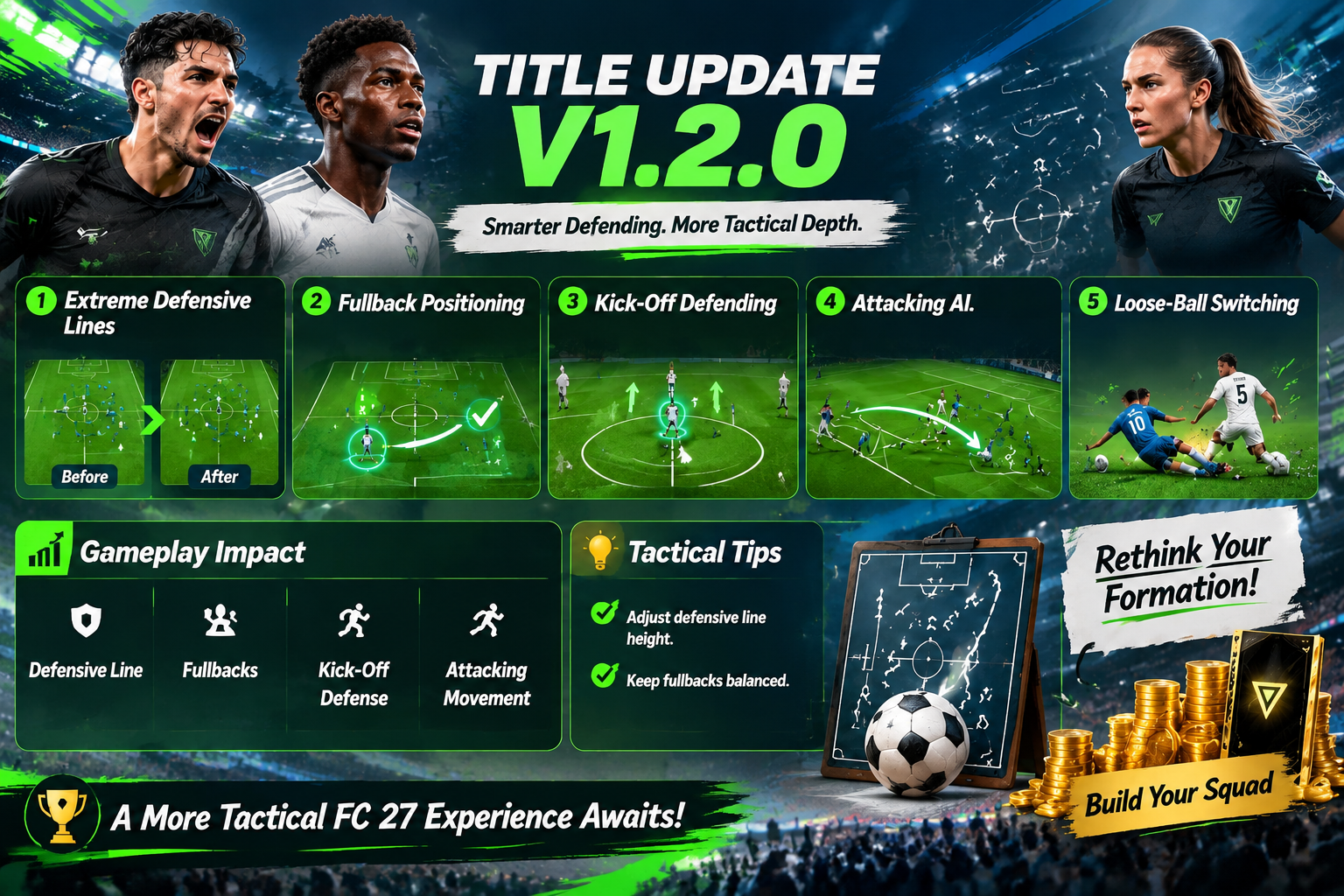
Defensive positioning has become an increasingly important part of the tactical battle in FC 27, particularly when teams rely on aggressive pressing and quick transitions to create scoring opportunities. The latest Title Update v1.2.0 introduces several targeted gameplay adjustments that could change how these strategies work in competitive matches. The main changes concern extreme defensive line heights, fullback positioning, kick-off defending, and player switching around loose balls. Attacking AI has also received improvements, giving forward players more effective supporting movement in certain situations. These adjustments make tactical awareness increasingly important, as players looking to strengthen their squads with Fut 27 Coins also need to consider how individual attributes fit into a more positionally demanding style of play.
Extreme Defensive Lines Receive More Controlled Positioning
One of the most significant changes concerns defenders operating with extreme defensive line heights. Aggressive defensive approaches can put considerable pressure on opponents by reducing the space available for building attacks. However, maintaining such a high line also creates opportunities for through balls and forward runs behind the defense. When the defensive structure pushes too far forward, a single well-timed pass can expose the space behind the center-backs and turn a promising pressing situation into a dangerous counterattack.
The latest adjustment changes how defenders respond to these extreme settings. They now drop off sooner while still maintaining a higher line than other tactical approaches. This behavior is being introduced through a Live Tuning Update alongside the title update, making it important to distinguish this targeted adjustment from a general reduction in defensive effectiveness. Players who frequently use extreme defensive depth may need to reconsider how much pressure they apply and how quickly their midfielders recover when possession is lost. The objective is not to eliminate aggressive defending, but to make its positioning more controlled.
Fullback positioning addresses another problem that can disrupt the defensive structure. Previously, fullbacks could drop too deep while defending, creating unnecessary gaps between wide defenders and the rest of the back line. This could leave attackers in wider positions with additional time to receive the ball, turn toward goal, and choose their next move. The revised behavior helps fullbacks maintain a firmer defensive line rather than retreating excessively toward the penalty area.
The difference becomes particularly noticeable when opponents try to stretch the defense through wide passing combinations. Wingers often look for space around the fullback, while overlapping midfielders and defenders create additional passing options. If the fullback retreats too early, the attacking team may gain more room to advance and draw other defenders out of position. More consistent positioning should make these situations harder to exploit, although defenders will still need to track genuine attacking runs instead of holding their positions blindly.
Kick-Off Defending Becomes Less Predictable to Exploit
Kick-off situations introduce another important change. Direct attacks immediately after restarting play have sometimes been effective because the defending team could retreat too deeply into its own penalty area. This created opportunities for attackers to advance quickly before the defensive structure had properly recovered. The updated behavior keeps the defensive line slightly higher immediately after kick-off and places a defensive player in a more central position, making it easier to defend against opponents attempting to dribble directly into the box.
This does not remove the possibility of scoring from an early attack, but it makes the immediate route toward goal less convenient. Players may need to approach these situations with more variation, using short passes, changes of direction, and movement across the pitch to create an opening. A direct forward run can still be useful when the defending team is poorly positioned, but repeating the same kick-off routine may become less effective against opponents who understand the revised defensive behavior.
Attacking AI and Loose-Ball Switching Get Improvements
The changes to attacking movement are closely connected to the defensive adjustments. Attackers are now better equipped to read the opposition’s defensive line and make more effective runs to stay onside. AI teammates also make more purposeful supporting runs and take better advantage of available space around the penalty area. This matters because a fullback holding a firmer line can create different opportunities for attackers, particularly when forward players time their movements carefully instead of relying on constant runs beyond the defense.
Another gameplay adjustment concerns loose-ball switching, an issue that can have a significant impact during crowded situations. Previously, automatic player switching did not always select the intended teammate after certain actions. This could happen following a headed pass, a missed shot, or a successful slide tackle. In these moments, the nearest player might be in the best position to contest possession, but delayed or incorrect switching could give the opponent an unnecessary advantage.
The revised switching behavior addresses these specific situations and should make player control more consistent when the ball becomes loose. A teammate completing a slide tackle, for example, may create an immediate opportunity to recover possession before the opponent can react. Similarly, after a missed shot, another attacker or defender may be better positioned to reach the rebound. More reliable switching can help players respond to these moments without losing valuable time selecting the appropriate footballer manually.
Attacking AI improvements provide another part of the update, particularly when teams move forward during counterattacks. Supporting attackers need to recognize when to make forward runs, when to hold their positions, and how to use the available space around the penalty area. Poorly timed movement can interrupt an otherwise promising attack, especially when a teammate moves beyond the defensive line before the ball can reach them. Better positioning and more purposeful supporting runs could make attacking combinations more effective, although players will still need to judge passing angles and timing carefully.
Several gameplay situations deserve attention when adapting to the revised mechanics:
- Extreme defensive line heights: Watch how defenders recover their positions when opponents attempt through balls or quick forward passes.
- Fullback positioning: Monitor whether wide defenders maintain a more consistent defensive line instead of retreating too deeply.
- Kick-off attacks: Use varied passing patterns and changes of direction rather than depending exclusively on immediate forward movement.
- Counterattacking runs: Pay attention to the timing of supporting players and the available space around the penalty area.
- Loose-ball situations: Observe how automatic switching responds after headers, missed shots, and slide tackles, particularly when several players are competing for possession.
- Defensive aggression: Consider the increased impact of the Defending Aggression CPU Slider when adjusting gameplay settings in supported modes.
How the Changes Could Affect Competitive Matches
These adjustments affect different stages of a match, but their combined impact becomes clearer when comparing the previous behavior with the revised mechanics.
| Gameplay area | Previous issue | Updated behavior | Tactical impact |
|---|---|---|---|
| Extreme defensive line heights | Defenders could remain too far forward | Defenders drop off sooner while maintaining a relatively high line | More attention to recovery runs and midfield support |
| Fullback positioning | Fullbacks sometimes retreated too deeply | Reduced instances of excessive defensive retreat | More consistent coverage of wide areas |
| Kick-off defense | The defensive line dropped too far toward the penalty area | The line stays slightly higher, with a defender positioned more centrally | Direct kick-off attacks become less straightforward |
| Attacking movement | Teammates could drift offside or make less effective supporting runs | Improved offside awareness and supporting movement | Better opportunities for coordinated forward runs |
| Loose-ball switching | Automatic switching could select the wrong player in specific situations | Improved switching after headers, missed shots, and slide tackles | More consistent reactions when contesting possession |
| Counterattacking AI | Attacking support inside the box could be less effective | Slight improvements to attacking AI in certain situations | More useful movement around the penalty area |
The adjustments also give players a reason to reconsider how individual attributes support their preferred formations. Center-backs need to handle recovery situations effectively, particularly when an aggressive defensive approach leaves space behind them. Fullbacks must balance their defensive responsibilities with the need to cover wide channels, while midfielders play an important role in preventing opponents from exploiting gaps between the lines. Attacking players, meanwhile, benefit from movement and positioning that allow them to take advantage of openings created during transitions.
Formation selection should therefore involve more than choosing a familiar arrangement and applying the same instructions in every match. A formation that performs well against a narrow attacking setup may struggle when opponents use wide players to stretch the defense. Similarly, an aggressive pressing approach may create possession opportunities but require additional midfield support when the opposition breaks through the first line of pressure. Testing different player roles and defensive approaches can help identify which combinations remain effective under the updated gameplay behavior.
Another interesting aspect is how these adjustments could influence competitive match variety. When a particular defensive setup becomes popular, players often develop similar attacking routines to exploit its weaknesses. Changes to defensive positioning and kick-off behavior could encourage more experimentation, particularly among players who rely on predictable passing sequences or repeated forward runs. The improvements to loose-ball switching also add another layer to these encounters, since recovering possession after a tackle or rebound can influence the outcome of an entire attacking sequence.
Adapting Tactical Decisions to the Updated Gameplay
Rather than replacing an entire tactical setup immediately, players can begin by reviewing the formations and instructions they already use. Testing different defensive line heights, observing fullback movement, and experimenting with alternative kick-off routines can reveal where adjustments are necessary. It is also worth paying attention to automatic switching during loose-ball situations and the positioning of AI teammates during counterattacks. These details can help distinguish between problems caused by tactical decisions and situations where improved player control or movement creates a better opportunity.
The latest gameplay update is ultimately about making defensive and attacking movement more consistent across several important match situations. Extreme defensive lines now involve a different recovery response, fullbacks are less likely to retreat excessively, kick-off situations offer less space for predictable direct attacks, and loose-ball switching has received targeted improvements. Combined with better attacking movement, these changes could encourage a more varied approach to both sides of the game. As players continue refining their formations and building competitive squads, exploring available FC 27 Packs can remain part of squad development, but understanding how individual players perform within the updated tactical environment will be just as important.